A weather balloon with a 2-meter diameter at ambient temperature holds 525 grams of helium. What type of electronic probe could be used to determine the pressure inside the balloon?
barometric
thermometric
calorimetric
spectrophotometric
Which would be most appropriate for collecting data during a neutralization reaction?
a pH probe
a statistics program
a thermometer
a graphing program
A scientist observed changes in the gas pressure of one mole of a gas in a sealed chamber with a fixed volume. To identify the source of the changes, the scientist should check for variations in the
air pressure outside the chamber.
molecular formula of the gas.
temperature of the chamber.
isotopes of the gas.
Electrical fires cannot be safely put out by dousing them with water. However, fire extinguishers that spray solid carbon dioxide on the fire work very effectively. This method works because carbon dioxide
displaces the oxygen.
renders the fire’s fuel non-flammable.
forms water vapor.
blows the fire out with strong wind currents.
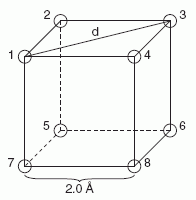
In the cubic crystal shown, if each edge is 2.0 angstroms in length, what is the diagonal distance, d, between atoms 1 and 3? (Assume that the Pythagorean theorem can be used to solve this problem.)
2.5 Å
Å
Å
Å
In order to advance to the level of a theory, a hypothesis should be
obviously accepted by most people.
a fully functional experiment.
in alignment with past theories.
repeatedly confirmed by experimentation.
Matter is made of atoms that have positive centers of neutrons and protons surrounded by a cloud of negatively charged electrons. This statement is
a theory.
a hypothesis.
an inference.
an observation.
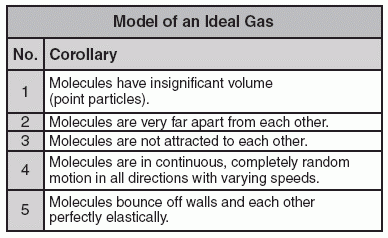
The model of ideal gases shown above is useful because it
accurately approximates the properties of most gas molecules.
predicts the behavior of other phases of matter.
gives precise explanations for nonideal gas behavior.
shows a linear relation between gas pressure and volume.
When a metal is heated in a flame, the flame has a distinctive color. This information was eventually extended to the study of stars because
the color spectra of stars indicate which elements are present.
a red shift in star color indicates stars are moving away.
star color indicates absolute distance.
it allows the observer to determine the size of stars.
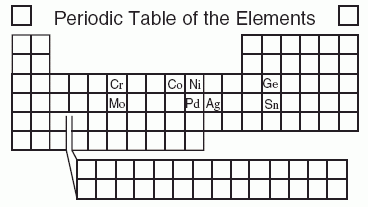
Which of the following ordered pairs of elements shows an increase in atomic number but a decrease in average atomic mass?
Ag to Pd
Co to Ni
Ge to Sn
Cr to Mo
Why is cobalt (Co) placed before nickel (Ni) on the periodic table of the elements even though it has a higher average atomic mass than nickel?
Nickel has one more proton.
Cobalt was discovered first.
Nickel has fewer electrons.
Cobalt has a lower density.
Generally, how do atomic masses vary throughout the periodic table of the elements?
They increase from left to right and top to bottom.
They increase from left to right and bottom to top.
They increase from right to left and top to bottom.
They increase from right to left and bottom to top.
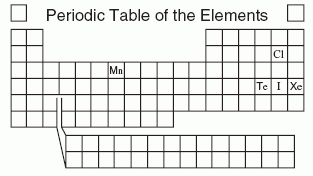
Iodine would have chemical properties most like
manganese (Mn).
tellurium (Te).
chlorine (Cl).
xenon (Xe).
Which of the following elements is classified as a metal?
bromine
helium
sulfur
lithium
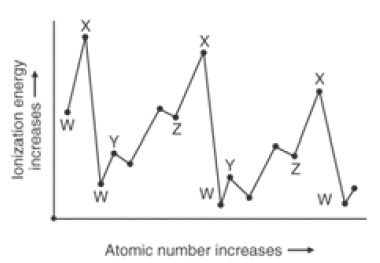
The chart above shows the relationship between the first ionization energy and the increase in atomic number. The letter on the chart for the alkali family of elements is
W
X
Y
Z
Which of the following atoms has the largest atomic radius?
barium (Ba)
chlorine (Cl)
iodine (I)
magnesium (Mg)
Which of the following atoms has six valence electrons?
magnesium (Mg)
silicon (Si)
sulfur (S)
argon (Ar)
Which statement best describes the density of an atom’s nucleus?
The nucleus occupies most of the atom’s volume but contains little of its mass.
The nucleus occupies very little of the atom’s volume and contains little of its mass.
The nucleus occupies most of the atom’s volume and contains most of its mass.
The nucleus occupies very little of the atom’s volume but contains most of its mass.
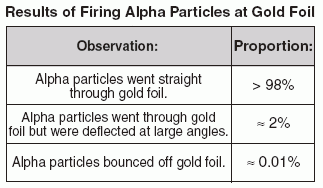
What information do the experimental results above reveal about the nucleus of the gold atom?
The nucleus contains less than half the mass of the atom.
The nucleus is small and is the densest part of the atom.
The nucleus contains small positive and negative particles.
The nucleus is large and occupies most of the atom’s space.
Why are enormous amounts of energy required to separate a nucleus into its component protons and neutrons even though the protons in the nucleus repel each other?
The force of the protons repelling each other is small compared to the attraction of the neutrons to each other.
The electrostatic forces acting between other atoms lowers the force of repulsion of the protons.
The interactions between neutrons and electrons neutralize the repulsive forces between the protons.
The forces holding the nucleus together are much stronger than the repulsion between the protons.
The most abundant isotope of lead contains 82 protons and 124 neutrons packed closely together in the nucleus. Why do the protons stay together in the nucleus rather than fly apart?
Electrons in neighboring atoms neutralize repulsive forces between protons.
Neutrons effectively block the protons and keep them far apart to prevent repulsion.
Electrostatic forces between neutrons and protons hold the nucleus together.
Nuclear forces overcome repulsive forces between protons in the nucleus.
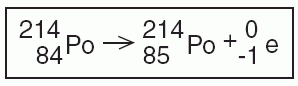
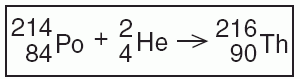
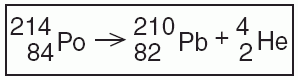
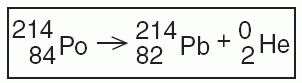
Which equation correctly represents the alpha decay of polonium-214?
A 2-cm-thick piece of cardboard placed over a radiation source would be most effective in protecting against which type of radiation?
alpha
beta
gamma
x-ray
Which of the following is a monatomic gas at STP?
chlorine
fluorine
helium
nitrogen
When cations and anions join, they form what kind of chemical bond?
ionic
metallic
hydrogen
covalent
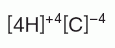
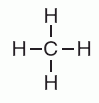
Which of the following correctly shows how carbon and hydrogen bond to form a compound?
Some of the molecules found in the human body are NH2CH2COOH (glycine), C6H12O6 (glucose), and CH3(CH2)16COOH (stearic acid). The bonds they form are
nuclear
metallic
ionic
covalent
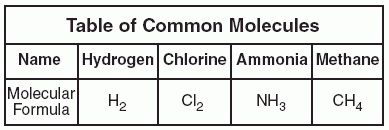
What type of bond do all of the molecules in the table above have in common?
covalent
ionic
metallic
polar
The reason salt crystals, such as KCl, hold together so well is because the cations are strongly attracted to
neighboring cations.
the protons in the neighboring nucleus.
free electrons in the crystals.
neighboring anions.
What type of force holds ions together in salts such as CaF2?
electrostatic
magnetic
gravitational
nuclear
Under the same conditions of pressure and temperature, a liquid differs from a gas because the molecules of the liquid
have no regular arrangement.
are in constant motion.
have stronger forces of attraction between them.
take the shape of the container they are in.
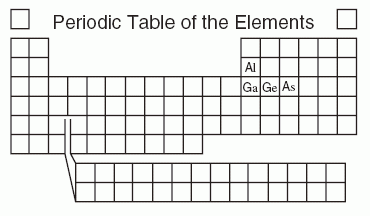
Which of the following elements has the same Lewis dot structure as silicon?
germanium (Ge)
aluminum (Al)
arsenic (As)
gallium (Ga)
Which substance is made up of many monomers joined together in long chains?
salt
protein
ethanol
propane
For the polymer, polyvinyl chloride,
(PVC), ~ CH2CH(Cl)CH2CH(Cl)CH2CH(Cl) ~
the repeating subunit is
CH(Cl)
CH(Cl)CHCH2.
CH2CH.
CH2CH(Cl).
Which element is capable of forming stable, extended chains of atoms through single, double, or triple bonds with itself?
carbon
oxygen
nitrogen
hydrogen
Proteins are large macromolecules composed of thousands of subunits. The structure of the protein depends on the sequence of
lipids.
monosaccharides.
amino acids.
nucleosides.
When a cold tire is inflated to a certain pressure and then is warmed up due to friction with the road, the pressure increases. This happens because the
air molecules hit the walls of the tire less frequently.
rubber in the tire reacts with oxygen in the atmosphere.
air molecules speed up and collide with the tire walls more often.
air molecules diffuse rapidly through the walls of the tire.
When someone standing at one end of a large room opens a bottle of vinegar, it may take several minutes for a person at the other end to smell it. Gas molecules at room temperature move at very high velocities, so what is responsible for the delay in detection of the vinegar?
the increase in the airspace occupied by vinegar molecules
the chemical reaction with nerves, which is slower than other sensory processes
attractive forces between the air and vinegar molecules
random collisions between the air and vinegar molecules
Methane (CH4) gas diffuses through air because the molecules are
moving randomly.
dissolving quickly.
traveling slowly.
expanding steadily
The volume of 400 mL of chlorine gas at 400 mm Hg is decreased to 200 mL at constant temperature. What is the new gas pressure?
400 mm Hg
300 mm Hg
800 mm Hg
650 mm Hg
Under what circumstance might a gas decrease in volume when heated?
The gas is held constant at STP.
The gas remains under uniform temperature.
The gas is placed under increasing pressure.
The gas undergoes a decrease in pressure.
A sample of carbon dioxide gas occupies a volume of 20 L at standard temperature and pressure (STP). What will be the volume of a sample of argon gas that has the same number of moles and pressure but twice the absolute temperature?
10 L
20 L
40 L
80 L
Standard temperature and pressure (STP) are defined as
0 °C and 1.0 atm pressure.
0 °C and 273 mm Hg pressure.
0 K and 1.0 atm pressure.
0 K and 760 mm Hg pressure.
Under which of the following sets of conditions will a 0.50 mole sample of helium occupy a volume of 11.2 liters?
298 K and 0.90 atm
273 K and 1.10 atm
373 K and 0.50 atm
273 K and 1.00 atm
What is the equivalent of 423 kelvin in degrees Celsius?
–223 °C
–23 °C
150 °C
696 °C
Theoretically, when an ideal gas in a closed container cools, the pressure will drop steadily until the pressure inside is essentially that of a vacuum. At what temperature should this occur?
0 °C
−460 °C
−273 K
0 K
The temperature at which all molecular motion stops is
−460 °C
−273 K.
0 K.
0 °C.
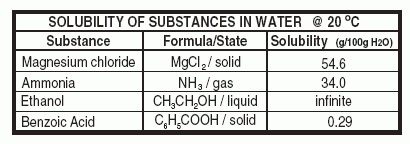
Which of the substances in the table can act as either the solute or the solvent when mixed with 100 grams of water at 20 °C?
NH3
C6H5COOH
MgCl2
CH3CH2OH
A teaspoon of dry coffee crystals dissolves when mixed in a cup of hot water. This process produces a coffee solution. The original crystals are classified as a
solute.
solvent.
reactant.
product.
If the attractive forces among solid particles are less than the attractive forces between the solid and a liquid, the solid will
probably form a new precipitate as its crystal lattice is broken and re-formed.
be unaffected because attractive forces within the crystal lattice are too strong for the dissolution to occur.
begin the process of melting to form a liquid.
dissolve as particles are pulled away from the crystal lattice by the liquid molecules.
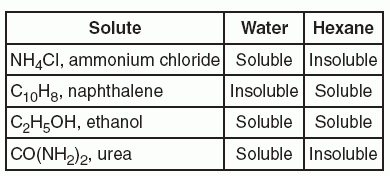
Water is a polar solvent, while hexane is a nonpolar solvent.
Which of the examples above illustrates a nonpolar solute in a polar solvent?
 Å
Å Å
Å Å
Å